
INTRODUCTION
The idea of a tour of South Devon chess clubs came to Roy Wagstaff at the Paignton Congress in 1974. Roy has been playing in the Paignton Congress for more years than he cares to remember (his phrase), usually taking a small contingent of local players with him. But the thought grew that Devon was a long way to go just for one week‘s play. Why not make it two? Using Paignton as a base, clubs at Plymouth, Exeter, Teignmouth, Totnes, Torquay and Paignton itself are within easy reach. The idea was put to several of the Devon people involved and enthusiastically received.
Then began the task of organising the venture – finding the players, writing to the clubs to arrange the fixtures (no small task). It was decided to make the tour as an official activity of Wanstead & Woodford Chess Club. The team was at last assembled: Ian Hunnable (178), Philip Gasper (166), Roy Wagstaff (162), Alan Potter (158) and Tim Southon (135). The last spot caused a problem and we eventually had to find a guest player, who was a junior, Jeffrey Goldberg of Ilford (113).
Matches were secured against Plymouth, Exeter, Totnes and Teignmouth. A team from Barnstaple were keen at the congress in 1974 but no match materialised. Exeter University were also tried, but said they would not have re-assembled at the time we were going. The entire organisation of the tour was undertaken by Roy Wagstaff and how successfully his work was rewarded can be seen from the following pages.
Part 1
The tour
Match 1
1st September,1975
| W & W | v | Plymouth | Opening | Moves |
|---|---|---|---|---|
| I.D. Hunnable 178 [W] | 0–1 | G.W. Wheeler 184 [B] | Dutch Defence | 27 |
| P.T.R. Gasper 166 | ½–½ | R.M. Bruce 175 | English | 45 |
| R.A. Wagstaff 162 | 1–0 | J.K. Gross 169 | Exchange Slav | 25 |
| Alan J. Potter 158 | ½–½ | H.R. Pearce 152 | English | 49 |
| T. Southon 135 | ½–½ | E.C. Prady 126 | English | 31 |
| J. Goldberg 113 | ½–½ | Jane Anson 104 | Sicilian Dragon | 39 |
| 3–3 |
42 moves in 1¾ hours.
The opening match of our tour, against the Plymouth club, took place at the home of Mr & Mrs Bruce, “Brent Whim”. Their kind invitation included tea before the match and a light supper afterwards. The sumptuous tea that awaited us was slightly intimidating for, after such kind hospitality, we could hardly be so ill-mannered as to beat them! (More of that later.)
The Bruce’s have the upper front room of their home laid out for a 6-board chess match and is a regular home venue for Plymouth’s Devon League matches.
Now to the play. A glance at the results above bears out the popular opinion that the English tends to be a drawish opening. In all, there was only one king’s pawn opening, which was met with a Sicilian dragon.
The first game to finish was that of Roy Wagstaff after just 40 minutes play; a win of such indecent haste that it caused embarrassment to the rest of the team lest we should appear so ill-mannered as to repay the Bruce’s hospitality by beating them. Moreover, Roy had the temerity to lay a trap into which his opponent unwittingly fell. Accordingly, the remainder of the team felt obliged to redress the balance and ensure the match was drawn. Thus winning chances in three of the other games had to be foregone. (At least, that’s our excuse!)
On board 1, with the players having castled on opposite sides, lively play resulted. In the complications, the Plymouth player shed a piece, though not without compensation, in the shape of an exposed enemy king. White failed to find a safe course and his king became trapped in a corner thus redressing the balance of the match.
The other two games in which we diplomatically eschewed winning chances were on boards 2 and 4. Both were unfinished when time was called (see diagrams below).
Diagram 1 shows Philip Gasper’s game after White’s 45th move. With 45 …Kf5 Black can still think in terms of winning. In the event he played 45 …g5 and after a little discussion the draw was agreed.
After 49 moves, with two passed pawns and a rook against lone rook, Alan Potter reached Diagram 2 and was confident of winning. The game was the last to finish and with the result from the other five being 2½–2½ we appeared in danger of winning. A venerable copy of Fine’s Basic Chess Endings was produced to show that the position was drawn. Black’s last move had been 49 …Rb3-b6. Instead, 49 …Rg3 was still winning.
1 Gasper (Black, to move)
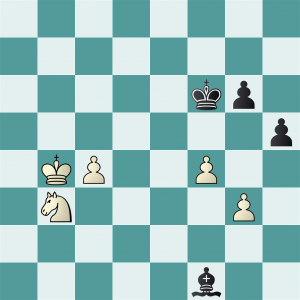
Bruce (White)
2 Potter
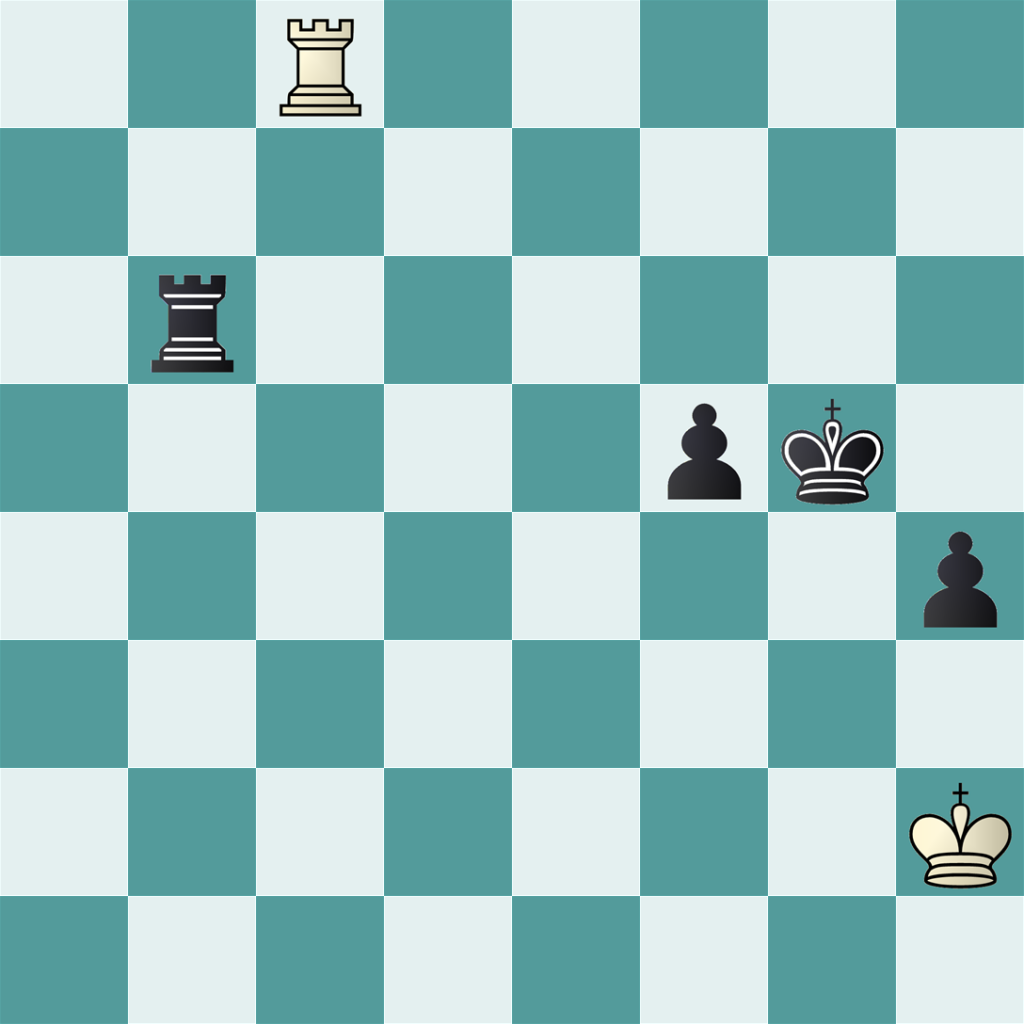
Pearce (White, to move)
The games on boards 5 and 6 passed with little event, both ending in drawn rook and pawn endings. On the 6th board, our guest player, Jeffrey Goldberg, from the Ilford club, was opposed by the 1974 British Girl’s U-18 Champion.
Match 2
3rd September, 1975
| W & W | v | Exeter | Opening | Moves |
|---|---|---|---|---|
| I.D. Hunnable [B] | 1–0 | R. Heasman [W] | Owen’s Defence | 36 |
| P.T.R. Gasper | 1–0 | B.W. Clapp | Bishop’s Opening | 25 |
| Alan J. Potter | 0–1 | S. Boniface | Pirc’s Defence | 22 |
| R.A. Wagstaff | 1–0 | L. Jones | Englund Gambit | 34 |
| T. Southon | ½–½ | M. Boag | Bird’s Opening | 47 |
| J. Goldberg | 0–1 | A. Paine | Bird’s Opening | 37 |
| 3½–2½ |
36 moves in 1½ hours.
Travelling was the only problem for us on tour. With only one car between six players, two had always to resort to public transport. For the Exeter match, the arrangement was that one of the train travellers would meet the car at the station. However, we failed to take into account that Exeter boasts not one, but two railway stations. The appointed train traveller waited at Exeter St. David’s while the car travellers waited at Exeter Central – an error that can best be put down as a positional oversight. With that hitch overcome, the team assembled at the comfortable HQ of the Exeter Chess Club, looking out directly at the north side of Exeter Cathedral. Boards 1 and 4 started early to facilitate catching the last train back to Paignton.
Thus Roy Wagstaff was presented with an excellent opportunity to finish first again. His opponent employed the Englund gambit (1 d4 e5) and seemed to be following Micawber philosophy (“something will turn up”). Nothing did turn up and Micawber’s king finished up being neatly trapped in the centre with rook and knight after 1½ hours’ play. Philip Gasper was next to finish after taking advantage of a weak move by his opponent, to break his position and establish a passed pawn on d6. So we were two up, but Alan Potter was on the receiving end of a fierce attack and was obliged to resign after 22 moves.
Ian Hunnable took the opportunity to try out Owen’s Defence to e4. Good play was obtained, but the win came only after errors on both sides:
So we led 3–1 and wanted ½ pt from the bottom two boards to win. Jeffrey Goldberg built an overwhelming position with little difficulty but went astray and eventually lost material to a pin.
Thus it was left to Tim Southon’s game to clinch the match. In the early part of the game Tim picked up two pawns almost at will. Then he proceeded to lose them with interest (50%). The final position of K, N & 2P (Exeter) v K,N & P (W & W) cast doubts on whether we would take the match. A little analysis, after time was called, showed the likelihood of a draw. Exeter were not convinced and so the position was passed to Peter Clarke for adjudication. His verdict of a draw meant we won the match 3½–2½.
Tuesday, 2nd and Thursday 4th September were free days which were occupied, believe it or not, by playing chess. However, five minute play was ruled out as we had forgotten to bring a clock! A substitute timing device was pressed into use – an egg-timer, purchased in Plymouth.
In this variety of speed chess1 the sand is equalised in both portions of the timer, giving 1 min 30 secs each (a 3-minute egg) and the timer is inverted after each move. Thus a player loses on time when he has taken 1 min 30 secs longer than his opponent. The idea was rapidly shelved when Alan Potter suddenly recalled that he had a chess clock in his car.
On the second free day a double-round five-minute tournament was held on the greensward on the seafront. The contestants were IDH, PTRG, TS and JG. The event, jointly won by IDH and PTRG each with 5/6, failed to draw the expected crowd, although we did engage the curiosity of a small dog.
1 Interestingly, modern digital chess timers now include this ‘egg-timer’ mode of play in the programmed time controls. But remember, it happened in Paignton, long before the digital age, when ‘egg-timer chess’ was real egg-timer chess!
Match 3
5th September,1975
| W & W | v | Totnes | Opening | Moves |
|---|---|---|---|---|
| I.D. Hunnable [W] | 1–0 | A. Cooper [B] | Pirc‘s Defence | 36 |
| P.T.R. Gasper | 1–0 | J. Dentith | Pirc‘s Defence | 25 |
| R.A. Wagstaff | 1–0 | A. Dunlop | 4 Pawns Attack | 22 |
| Alan J. Potter | 1–0 | F. Chambers | Pirc‘s Defence | 34 |
| T. Southon | 1–0 | E. Cooper | Grunfeld Defence | 47 |
| J. Goldberg | 1–0 | C. Deakin | QP Budapest Def. | 37 |
| 6–0 |
36 moves in 1½ hours.
The day of the Totnes match was spent doing the two-way Dart River boat trip Totnes–Dartmouth–Totnes, having travelled to Totnes in the morning. The river trip did not actually take place until 3.00 pm through lack of water (the tide was out). Suggestions flowed as to how the match would be played should we become stuck on a sand bank and whether in such circumstances one should play the Canal variation. No such disaster occurred and, suitably fortified with seas breezes, we sailed into Totnes.
Wagstaff does it again! His third win in three, this time taking 1¾ hours. His four pawns attack swept up the board, meeting only a modicum of resistance, and completely encircled the king’s position. As Roy said: “not a great four pawns, but a pleasing four pawns!”.
Then, after another 45 minutes play three more wins rolled in, in quick succession. Alan Potter was the first of them. He could hardly have relished the black pieces again after his experience at Exeter, but was bold enough to employ the same opening. Things worked out much better, Alan winning a K-side pawn by means of a simple tactical device and subsequently trapped the exposed king.
Philip Gasper finished a minute later, also playing the black side of Pirc’s Defence. White delayed his Q-side development in favour of pushing his attack in the centre with the result that his forces became disorganised. In wriggling out of a situation in which he was losing a piece, White had to let an enemy pawn run in for a touch down. Two minutes later, Tim Southon scored his first win on tour. The Totnes player played a bad move early in a Grunfeld defence and was duly crushed.
Thus the match was already won but it was clear top and bottom boards were going to make it a clean sweep. At the top Ian Hunnable conducted a sharp attack against the third Pirc defence of the match, laying bare the Black king. The monarch was hunted across the board and finally perished on a5 with a neat mating combination.
Jeffrey Goldberg’s game was unfinished when time was called, but his two extra pawns in a R & P ending enabled the result to be quickly agreed. The game was a Budapest Defence – not often seen – in which it seemed the players had tacitly agreed not to have too many pieces in play at one time; when the board began to look crowded, exchanges were arranged to rectify matters.
The Totnes players took their beating in good spirit. They were undoubtedly the weakest of the clubs we met on tour, but were happy to give us a match, whereas others we wrote to either did not want to trouble to play, or did not reply at all. Totnes play in the relaxed country way where time is immaterial – a far cry from the hurly burly of London and Essex League matches where one has to start promptly to vacate the premises on time. Even at the late hour of 11 pm, after the equipment was cleared away, we were kindly invited back to the home of Mr. Chambers (board 4) for coffee and cheese & biscuits.
Match 4
6th September, 1975
| W & W | v | Teignmouth | Opening | Moves |
|---|---|---|---|---|
| I.D. Hunnable [B] | 0–1 | I.S. Annetts [W] | Owen’s Defence | 13 moves |
| P.T.R. Gasper | 1–0 | R.S. Thynne | Larsen’s | 42 |
| R.A. Wagstaff | 1–0 | P.A. Halmkin | Pirc’s Defence | 40 |
| Alan J. Potter | 0–1 | R. Liggitt | Grunfeld Defence | 48 |
| T. Southon | 0–1 | P. Walden | English | 30 |
| J. Goldberg | 0–1 | C.F.J. Fisher | Colle | 33 |
| 2–4 |
42 moves in 1¾ hours.
The warm reception we found at Plymouth, Exeter and Totnes was also afforded us at Teignmouth who expressed themselves flattered that a distant club should want to pay them a visit.
The match started with a sensation, Ian Hunnable losing in just 13 moves. His continued experimentation with Owen’s defence, used successfully at Exeter, went badly awry; castling too early, he left himself open to a mating attack. Ian’s excuse was that he wanted to prevent Roy Wagstaff repeating his party trick of finishing first. Nevertheless, Roy was next to finish, with his fourth win. This time, however, the game went to 3 hours. As Roy said: “It takes longer with black”.
After reaching the position below, White thought it would be a good idea to attack the rook, but falls foul of a devious queen check:
The two bottom boards followed, by which time it was clear we were losing the match. Tim Southon got involved in tactical complications and shed two pawns. Tim subsequently imagined a piece sacrifice would trap the enemy king, but resigned when White demonstrated the simple defence. Jeffrey Goldberg was sailing along quite happily when his queen got into difficulties. It could be extracted only at the cost of a piece.
The other two games were unfinished at time. Philip was looking quite lost in the opening but had his opponent to thank for not pressing his advantage. Recovering well, Philip proceeded to an endgame a pawn up. A simple win was demonstrated and Black resigned. Alan Potter’s final position had less to offer and by now we needed a whole point to draw. Alan was winning in the early stages and picked up a pawn. however, it was almost immediately given back in a position of some disadvantage and soon Black was a pawn up. The only other point of interest was the position in which Black managed to line up all his pieces on his third rank. With his bishop imprisoned at the close, the best Alan could hope for was a draw. The position was passed to Peter Clarke for adjudication and was returned as a win for Teignmouth. Thus occurred our only loss of the four matches.
SUMMARY
The reader may detect in these notes a mild leg-pull at the expense of Roy Wagstaff, born, no doubt, of a feeling of envy for his efficiency in despatching opponents. The opposition we encountered was modest, for those clubs that could outgrade us fielded teams to match our gradings which we had declared beforehand.
As a pioneer, the tour was a success. We were given a warm welcome wherever we went and our progress was followed with interest by the four clubs played. The only drawback, which, however, was not serious, was the question of transport. With only one car between six, two of us had always to go by bus or train. Public transport in Devon, as most rural areas, does not continue much after 9.30 pm thus presenting problems for evening matches. It is preferable, therefore, to have the whole team car-borne.
The venture is certainly open to repetition and on a larger scale (10 boards? 12 boards?). Parting words usually included “when you come next time…” and the Bruces insisted there be a next time.
As an acknowledgement to the kindness shown to us we presented a memento of a chess book to each club, inscribed and autographed by each of us.
RECORDS
Team
Played: 4; Won: 2; Drew: 1; Lost: 1. Points: For 14½; Against 9½.
| Opponents | Result | Score |
|---|---|---|
| v Plymouth | Drew | 3–3 |
| v Exeter | Won | 3½–2½ |
| v Totnes | Won | 6–0 |
| v Teignmouth | Lost | 2–4 |
Players’ Records
| Ave Bd | P | W | D | L | Pts | Colours | |
|---|---|---|---|---|---|---|---|
| R.A. Wagstaff | 3.25 | 4 | 4 | 0 | 0 | 4 | 3W 1B |
| P.T.R. Gasper | 2.00 | 4 | 3 | 1 | 0 | 3½ | 2W 2B |
| I.D. Hunnable | 1.00 | 4 | 2 | 0 | 2 | 2 | 2W 2B |
| T.E. Southon | 5.00 | 4 | 1 | 2 | 1 | 2 | 2W 2B |
| Alan J. Potter | 3.75 | 4 | 1 | 1 | 2 | 1½ | 1W 3B |
| J. Goldberg | 6.00 | 4 | 1 | 1 | 2 | 1½ | 2W 2B |
Part 2
The Paignton Congress
The Paignton congress is one of the most enjoyable in the chess calendar and takes place in the palatial surroundings of Oldway Mansion. Starting on the first Sunday in September, the 1975 Congress started as late as 7th September. Thus we toured in the first week in September; in another year the corresponding time could be up to a week earlier.
Ian Hunnable, Philip Gasper, Roy Wagstaff and Alan Potter had entered the Challengers section, Tim Southon the Premier Reserves and Jeffrey Goldberg the Graded Swiss. The Challengers is usually split into two tournaments because of the number of entries. Messrs. Hunnable, Gasper and Potter were put in the “B” section and Roy Wagstaff in the “A”. The three in the “B” section finished the tournament with identical records of +3, =4 and no losses to come =2nd with 5 pts; a remarkable feat. Roy Wagstaff provided a complete contrast to his quick finishes in the tour games – two of his congress games went to three sessions (i.e. over 6½ hours play) one of them exceeding 100 moves, and twice playing two sessions. Thus on the rare occasions when one of the others had an adjournment they had only to consult Roy to ascertain the time of the adjournment session. Roy secured 4½ points from +3, =3, -1. Tim Southon found the opposition in the Premier Reserves a little on the tough side but wanted the experience. His score was 2/7. Jeffrey Goldberg, in the lowest tournament scored 4½/7 and just managed to scrape into the prize list.
An interesting facet of the congress was to note the fairings of opponents we had met on tour. Ian Hunnable found himself confronted in the first round by his opponent from the Totnes match, A. Cooper, and beat him again, this time with black. Philip Gasper also had to play Cooper, in a later round, but only drew. The Teignmouth board 5, P. Walden, was in Challengers “A” and was contending for joint 1st place in the last round. Ron Bruce and G.W. Wheeler (both Plymouth) were playing in the Premier. S. Boniface of Exeter was in Challengers “B” and was leading at the start of the last round but got pipped at the post, finishing with 5.
Generally, we seemed to achieve better results in the congress than the tour matches – the result of knocking off the closed season rust before the congress?