
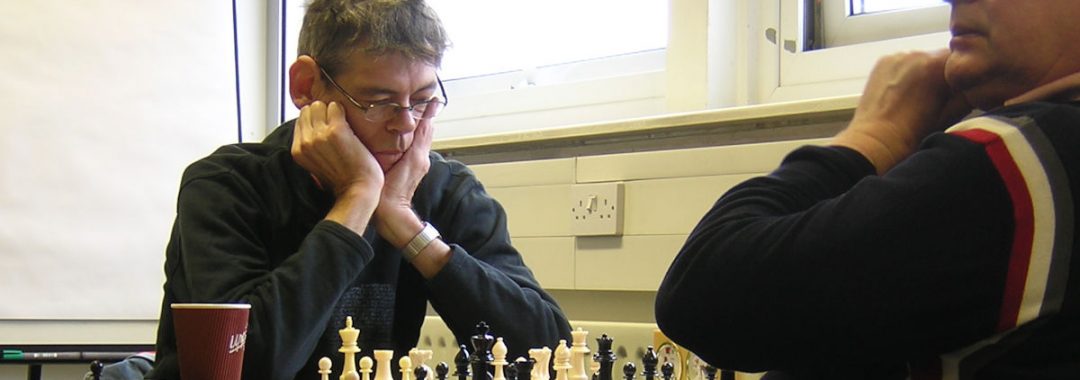
By Ian Hunnable
I first encountered Laurence E Marden at the Ilford Chess Congress, May 1969. Larry was three and a half years younger; I was 20, he was a Junior.
The Ilford Congress in those days was a range of graded 6 player all-play-alls – Premier, Premier Reserves, Major, Minor, Junior; that was how congresses were played in those days, the weekend Swiss had not yet been invented. We met in Major E, Round 4.
After 25 moves we had reached this position:
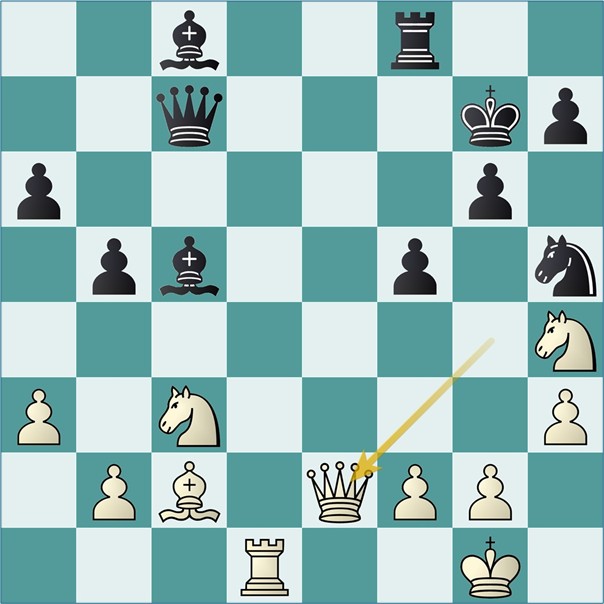
I was White and had just played 25 Qe2 after a trade of pawns on f5. It’s not a great position, we both have a knight on the side (though mine is going nowhere, while his can go …Nf4). I expect I was looking at Black’s exposed king and probably wanting to get my bishop to b3 and thinking that Nd5 would cause some problems, though Larry’s bishops look dangerous. e.g. after …Bb7. I certainly had no idea that I should need to resign after my next move.
At this point Larry unleashed: 25 … Qg3! Ouch! 26 Nf3? Seemed forced, but I didn’t see the saving move 26 Rd3! when 26 … Qxh4 is answered by 27 Qe5+ followed by 28 Qxc5. After my 26 Nf3? Larry followed up with 26 … Nf4 and I had to resign! 27 Qf1 is forced, then comes 27 … Nxh3+ 28 Kh1 Nxf2+ 29 Kg1 Nxd1+ 30 Kh1 Nh2+ 31 Kg1 Ng4. While for the moment there is no mate threat, I am a rook and two pawns down and facing the threat of …Qf4 and Qh6+ and his QB can enter the fray on b7, etc., e.g. 32 g3 to answer 32 …Qh6+ with 33 Nh4, then 33 …Bb7 wins more material. “How do you do, Larry!”
By the time of our second meeting, February 1971, Larry was Essex Junior Champion. He was playing for East Ham in the London League, played at Wanstead, and the match sheet paired us together on board 4. With the above sharp defeat still in my mind, I was not looking forward to this encounter, especially with the black pieces. But after 16 moves I made a pawn capture on d4 and he unwisely captured this poisoned pawn with a knight. I captured his errant knight and he had to resign as, were he to recapture, I had a check to win a rook.
Laurence Edward Marden was born on 25 January 1952 and died on 11 July 2025, having sustained a deblilitating stroke over Christmas/New Year 2019-20. Covid was soon to engulf the planet and Larry became one of its patients, though came through it.
Larry joined the Club in 1982. (For years he was “Laurie” to us, until the day he signed off an email as “Larry”.) In the intervening 43 years until his illness, he gave sterling service both as a fine player and captain of our London League 1st team. He was appointed to the captaincy by the Committee on 10 October 1989.
The circumstances of his appointment were unusual and traumatic, because he succeeded Roy Wagstaff as London League 1st Team Captain after Roy’s sudden death from a heart attack only a week or two before the AGM that year. While we proceeded with the meeting, it was too soon for us to have found a successor to Roy as LL1 captain, so it was referred to the Committee. Larry was to hold that position for 30 seasons, and part way through his 31st season when forced to relinquish through his illness over Christmas/New Year 2019-20, which not only robbed us of a team captain, it also ended his chess career. His captaincy of the London League 1st Team was the longest tenure of a Club captaincy of one team in the Club’s history.
Larry was a highly intelligent man, widely read, with views, I suspect, on a wide range of topics – always insightful and inclined to throw a new light on a topic you thought you understood. As I have suggested above, however, this is only a supposition – an extrapolation – based for instance on a conversation travelling to or from a chess game, when Larry expressed the view that it was unfair on train operators always to get complaints about their trains being late, when it was not possible for them to be early. “Because they can’t depart from a station stop before the timetabled departure time?” I responded, which he confirmed was his point; they can arrive early, but they can’t depart early. I hadn’t thought about it quite like that.
Above all, he was a quiet man; I never once heard him raise his voice.
Philip Staniland’s address at Larry’s funeral, 6 August 2025
“For so many of us in the chess community, Larry was a familiar and much-loved presence — someone we shared matches with, analysed games alongside, captained and were captained by, and above all, enjoyed spending time with. His absence is deeply felt, and it’s a testament to his character that so many of us are here today to honour him.
Larry was a true chess man. For many years, he was the captain of Wanstead & Woodford’s London League First Team — in fact, he held that role continuously for over 30 years, from 1989 until illness forced him to step back in 2020. That’s a staggering run of service. In that time, he also served on the London Chess League Committee as a players’ representative and was a regular for Essex in both Open and U175/U180 matches, contributing to many championship wins.
“He played sharp, attacking chess — the kind that made you brace yourself as soon as he picked up a piece. And yet, for all the fire on the board, he was calm, funny, gentle, and generous off it. He had a way of making people feel at ease — a dry wit, a wealth of stories, and a knack for analysis that made post-match conversations every bit as enjoyable as the games themselves.
“When I was thinking of all the offhand but insightful comments Larry made about chess over the years, one stood out for me. It occurred when analyzing a line in an adjourned game, a particularly wild game in which several pieces were left en prise, when someone suggested that the position was too “loose”. Larry smiled and echoed a line often attributed to Mikhail Tal: Larry simply said “It’s fine — he can only take one of them.”. I think this captured his approach perfectly: thoughtful, unfazed by complexity, and always seeing the bigger picture on and off the board.
“Larry wasn’t just a strong player — he was a fixture in the club. He represented Wanstead on top boards, turned out reliably for the County teams, and was always there when you needed someone — whether to play, to support, or simply to enjoy the game. He was Essex Junior Champion back in 1970–71, and even fifty years on, he remained a force to be reckoned with: joint leader in the Club Championship in the season when illness finally struck.
“He once described chess as an addiction — and I think it’s fair to say there are few who lived that more fully. Even when he could no longer attend in person, he continued to play online with me. There was always a game in progress. And those quiet, ongoing games became a constant thread of chess running through both our lives for the last five years. I still have the final position of our last game set up on my board at home. I haven’t had the heart to reset it.
“We’ll all remember Larry in our own way. But I think many of us would agree — he was a quiet hero. A constant presence in our chess lives. And a reminder that in chess, as in life, it’s not just about winning — it’s about how you play, and who you share the game with.”
Philip.
Mark Murrell remembers
The 2019-2020 season was in full swing when Larry suffered a series of strokes over the Christmas/New Year break. At that time he was joint leader in the Club Championship after four rounds, having held Steve Rix, his last over-the-board opponent, to a draw. Larry had also taken his London League team into a strong position in Division 2, with three wins out of four before he was forced to step aside. Larry was the Club’s longest continuously serving captain of the same team, having been appointed by the Committee to the London League 1st team captaincy on 10 October 1989 and therefore in his 31st season, 2019-20. He also served on the London League Committee as a player’s representative. In his Junior days he was Essex Junior Champion 1970-71.
With his extensive chess knowledge and a tactical, often attacking game, he was a long standing top order club player, a mainstay of every first team for the Club, and from time to time taking board 1. A regular at the annual Hastings match away day and in our National Club exploits. 2009-10 Club Champion (shared and surprisingly just the once), five times Blitz Champion, four times Lightning Champion and Rapid Champion once.
He was an almost ever-present first and second team player for Essex and part of many championship winning teams.
Notwithstanding his physical limitations since his illness, he spent his final years in a series of online correspondence games with Philip, maintaining his tactical flare.
Larry described chess as an addiction. There are very few members of longer standing and none as addicted.
We have already missed his presence of course with his quirky anecdotes, chessboard pumps, and insightful analysis.
At the chess board Larry was an artist
I have prepared a selection of Larry’s games and playing through them, put me in mind of a quotation I once heard:
“An artist is someone who can hold two opposing viewpoints and still remain fully functional.” ― F. Scott Fitzgerald
By this measuring stick, at the chessboard Larry was an artist:
Larry played several openings from both sides and whichever side he was playing, he believed he could win, and indeed did so:
Queen’s Gambit Accepted
Larry made deep analysis of the QGA from Black’s viewpoint and satisfied himself that not only was it safe to accept the gambit he thought he had refuted it – or at least one line of it. But he also played 1 d4 as White and when Black played …d5, Larry didn’t avoid the issue but happily offered the Queen’s Gambit as White: offering the very same gambit for which he had found a refutation as Black. And if Black accepted the gambit Larry proceeded to win with White.
Grunfeld Defence
Larry also played the Grunfeld defence with White and Black and won from both sides.
So if you play the same opening from either side and, rather than avoiding it by playing something else, and win with both colours I think that satisfies Fitzgerald’s definition of an artist.
The database of Larry’s games, which you can find further down the page, includes examples of the above duality; see for yourself.
Larry also made an in depth analysis of the Fried Liver attack from Black’s viewpoint and reckoned he had refuted it. I recall a train journey returning from a National Club away fixture when I found myself participating in just such an analysis session – Larry had defeated the Fried Liver in the game from which we were returning so he was analysing his game on his travel set. So it was not simply going through the game he had just won, but adding to his ongoing deep analysis of that line, so on this occasion I was acting as a sounding board to bounce ideas off. I supplied replies for White but Larry’s insightful play for Black held firm and the best I was able to achieve was an assessment of a position as “unclear”. The game in question is included in the selection of Larry’s games: it was a game in the National Club Championship away to Rose Foregrove – Iain Smith – Larry Marden, 22 April 2001.
Not only chess…
Larry’s tastes in music were indicated with the Entrance Music at the service: “Will the circle be unbroken” sung by the Nitty Gritty Dirt Band, Johnny Cash and Ricky Staggs, which was said to be his favourite track, and the Exit music “September Song” sung by Lou Reed from the film September Songs – the Music of Kurt Weill. Links below.
“Will the circle be unbroken”: Link to the track on Spotify
“September Song”: Link to track on Spotify
We also heard of Larry’s other interests: he once, with Caroline, ran a film society. He also played golf and was an ace tennis player, particularly good with the volley – with his height and long reach this conjours up an image of a whirling Dervish.
To add…
- Games database
- Selection of pictures in a Gallery or Slideshow