
By Webmaster, Ian Hunnable
Contents
- Club Foundation and move to West Ham Hall/Wanstead House
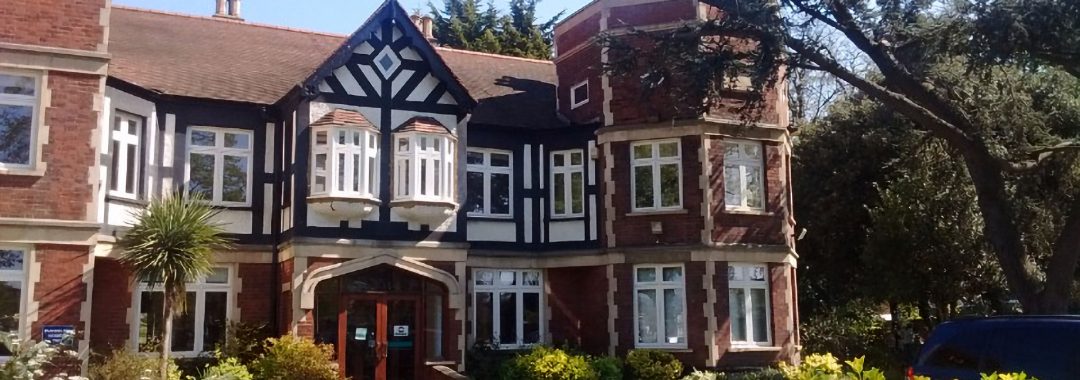
- Brief History of West Ham Hall/Wanstead House
- Celebratory Match – 2 October 1946
- Club Members and Wanstead House
Return to this menu by clicking on the ‘ghost up arrow’ icon always visible in the bottom right corner of the page.
Club Foundation and move to West Ham Hall/Wanstead House
The Club was founded in 1943 and for the first few years of its existence was based at Wanstead County High School in Redbridge Lane West (now “Wanstead High School”). Although the first Annual General Meeting was held on Thursday 2nd August 1945, the founding of the Club was late in the 1942-43 League season and the first annual subscription of members was held to embrace the 1943-44 season. The inaugural meeting of the Club, at which the Club was officially formed, was held on 16 October 1943.
By the first Annual General Meeting, the Club had been in existence for a year and 10 months. And yet, the Minutes of the first AGM record that two representatives of the Wanstead & Woodford Community Association (as it was then called) were in attendance to give the Club an idea of the aims and scope of the Association. The Minutes go on to record that “Mr Wagstaff, who had been in communication with the Association regarding the possible affiliation of the Club, then introduced Mr Hart.” After acquainting the meeting with the nature of the Association, Mr Hart explained that “It was intended to establish a Centre or Centres in the district, to which end they had acquired the lease of West Ham Hall”. This was in fact the name at the time of what we now know as Wanstead House. Mr Hart went on to say, “When released by the military this would be available for the use of members.”
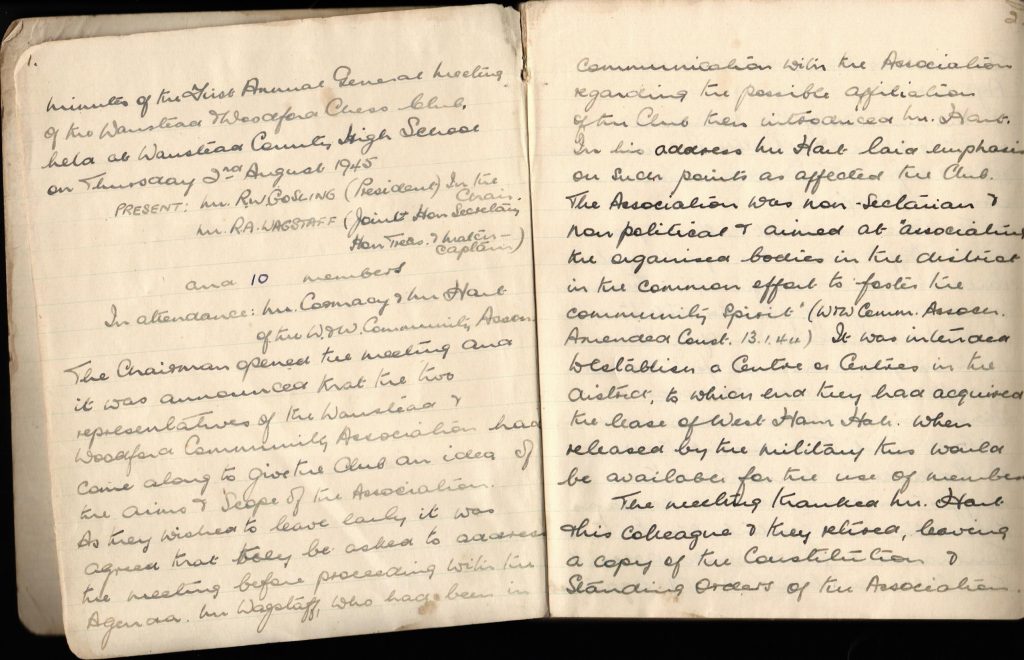
Minutes of the first AGM taken by Club Secretary John Hunnable
Brief History of West Ham Hall/Wanstead House
The property, which was built in 1914 and originally named ‘Ranceval’, belonged to Margaret Meekings Johnson OBE ARRC, having purchased it in August 1920 and renamed it “West Ham Hall”, after her family home in Sebert Road, Forest Gate, which itself was compulsorily purchased in 1890 by the railway and demolished to extend what would be eventually the Gospel Oak to Barking line.
Margaret Meekings Johnson OBE ARRC was a highly respected nurse whose career was defined by leadership in public and military health, particularly in the Essex area.
The article in Wanstead Village Directory entitled ‘Her Story’ describes the family then moving to Loughton. On the death of her father in 1909, Margaret and her mother moved to another house in Loughton, where her mother died in 1919. Following that further bereavement, Margaret moved to Wanstead and brought the gate from Sebert Road here, renaming the house West Ham Hall. Yet it was 30 years since the family had left West Ham Hall, Forest Gate. When Margaret finally moved to Wanstead, did she locate the gate after 30 years? Or had the family taken the gate with them on their previous two moves? Perhaps we will never know.
After Margaret’s death in 1940 her last resting place was at some point requisitioned by the army for use as a rehabilitation centre or possibly an officers’ mess.
Celebratory Match – 2 October 1946
The Club’s move from Wanstead County High School in Redbridge Lane West to Wanstead House in 1946, becoming a Constituent Body of the Association from Day 1, was celebrated on the Opening Night of the new season, Wednesday, 2nd October 1946, with a match between teams of members resident in Wanstead and those resident in Woodford. Wanstead won by 6½-5½. The Club had relocated to Wanstead House some months previously as the second AGM was held there on 29 May 1946.
We have plans to celebrate our 80th year here with a similar match, 80 years to the day, on Friday 2nd October 2026, when the teams will be named after the Club’s co-founders, Roy Wagstaff and John Hunnable – father of our Chairman and Webmaster, Ian Hunnable – the teams to be selected by our Fixtures Secretary.
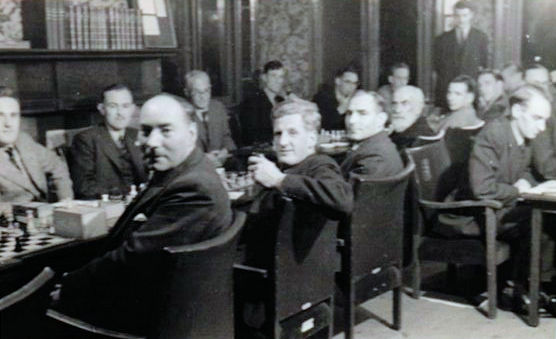
In this picture of that original match in 1946, held in Roding Room, (though you might not recognise it!) Roy Wagstaff is standing in the background by the windows and John Hunnable is the figure on the end table, right edge of the frame. Not a great picture of either, but this is the only one of the few that we have which shows them both in the same shot.
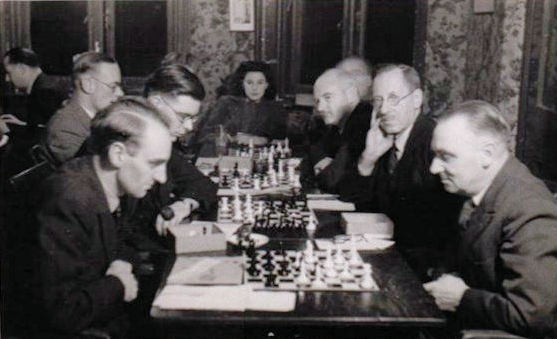
In this close-up of Boards 9-12, John Hunnable, foreground left, smoking a pipe – in those days smoking was not prohibited in the playing room! – is Club Secretary, later Treasurer. It is his Minutes quoted above with an image of the original Minute book. Also left of picture, the gentleman immediately beyond John Hunnable, is Tom Cocking, the solicitor who, in 1969, drew up the Trust Deed of the David Wood Memorial Trust. We do not know the identity of the woman spectator at the far end of this row.
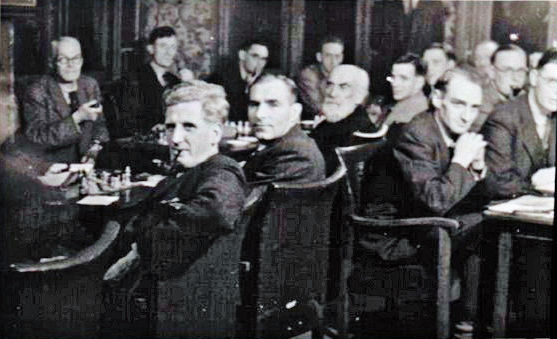
In this, slightly closer view of the top eight boards, the figure centre background – far side of the table, fourth head from the left – is my maternal grandfather, Jonathan Mason, playing Board 1 against Club Champion Jack Hawson. The gentleman in the foreground with the wavy hair, smoking a pipe is Howard Hutchins, later Club Secretary.
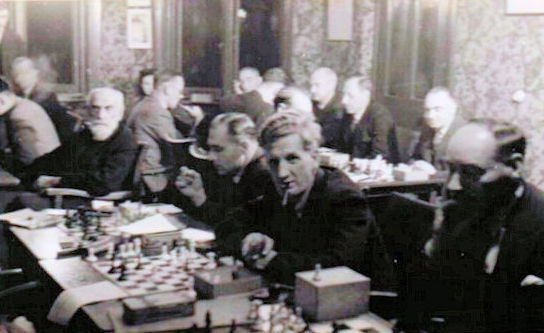
Finally, in this slightly less formal “snap” featuring Howard Hutchins, centre, the scoresheets are in evidence, confirming this is a competitive match. The shot also shows clearly the connecting door to Manor Room (upper right). This door is still there, but has been boarded over on both sides; much less expensive to leave it in place rather than incur the cost of having it bricked up.
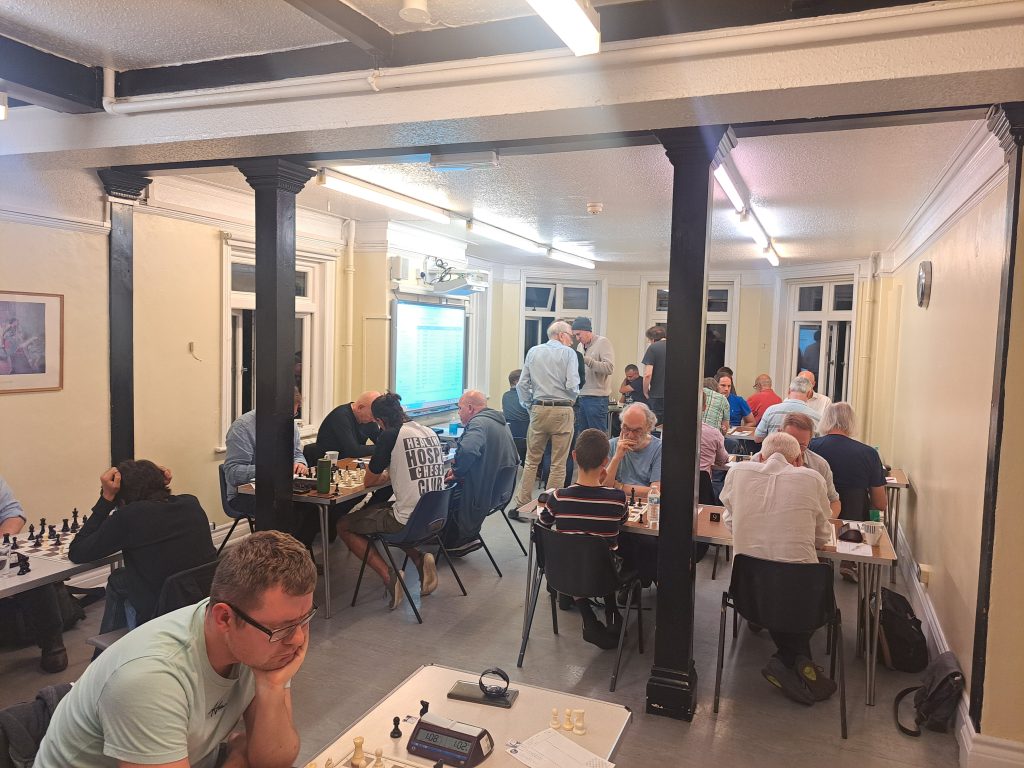
One thing is noticeable in these pictures of that match in 1946, which is the crowded nature of the room. Apart from the furniture, with the fairly deep armchairs (front to back) we believe Roding Room in those days was before it had been extended. Therefore the back wall was where the black painted pillars are today – see the recent picture (right). The door into that bedroom would have been on the right of picture between the wall on the right and the pillar next to it (between the player at the bottom of the picture and the pillars), and the area nearest the camera – what we refer to as the “cupboard end” of the room – would have been another bedroom and the space between them, continuation of the corridor from the top of the stairs. Hence, the photographer of the above 1946 pictures could neither get further away, nor could the near left corner of the room be included in the other shots, except that there was apparently room to stand there for the fourth picture.
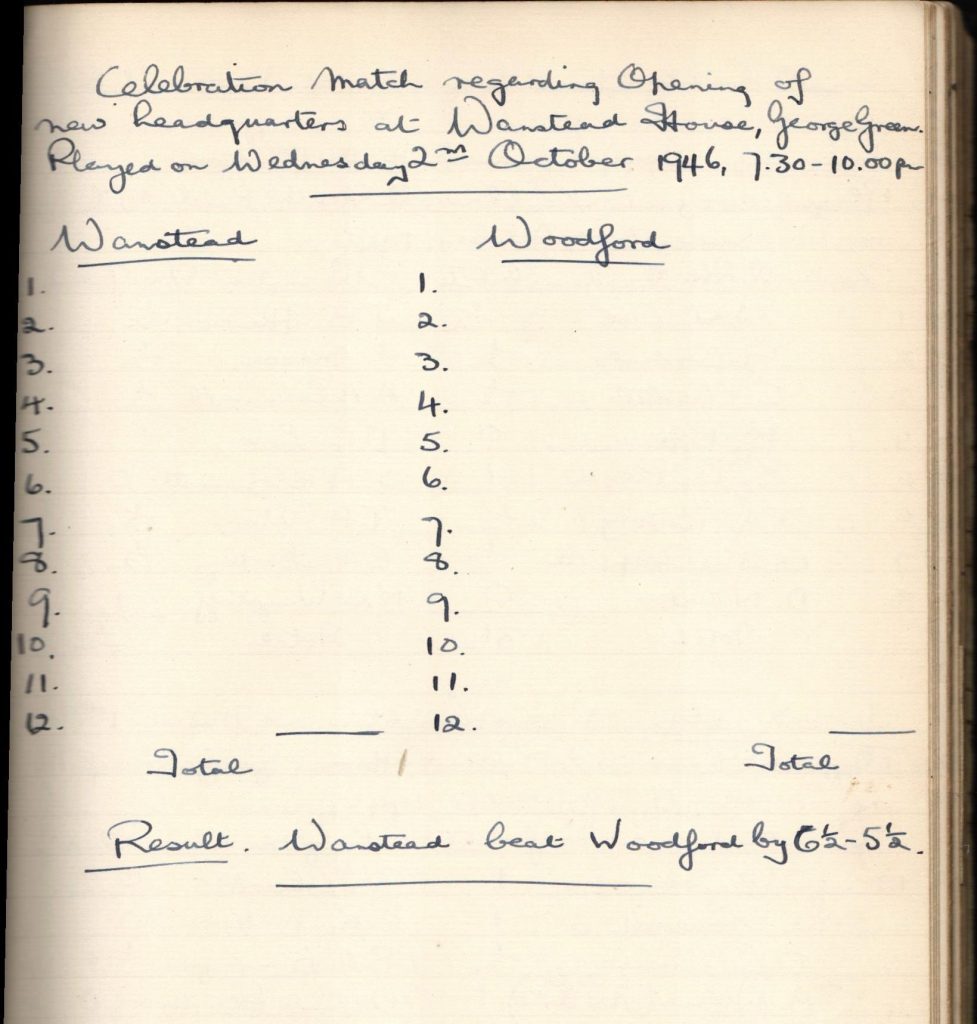
Unfortunately, we do not have the details of the individual players or board results. While Roy Wagstaff made detailed records of individual matches for all the Club’s other fixtures in those early seasons, the “Celebration Match” was one that was only “topped and tailed”, but at least he had recorded the purpose of the match and its result! The above pictures of the event, which have come to the Webmaster, along with Roy Wagstaff’s scorebooks and other chess papers, are otherwise unidentified, but allowing for the fact that the gentleman nearest the camera in the title picture (top) is on Board 7, the back of the chair to his left is Board 8, then the second picture shows Boards 9-12 and ties up with the record (left) notwithstanding the missing names. The clinching proof that these pictures record the celebratory match is that they must have been taken by a photographer from the local press. The games are clearly already in progress and the main shot is posed with all players looking at the camera; only a press photograph arranged to cover the event could persuade all the players to break off their games and “smile for the camera”! Don’t let the absence of clocks fool you: the Club didn’t own any at that time!
Some private clocks might have been in use and the Club may have had a few clocks but due to wartime privations, there may not have been many, or indeed any available to be purchased. The Minutes of the Second AGM, 29 May 1946, record that the Secretary drew attention to the Club’s need for equipment and “proposed that a fund be inaugurated to collect money for this purpose”. He emphasised that “the Club should look ahead to the time when chess sets would be freely available again.” Although this proposal was duly seconded it was overturned by an amendment to pay for equipment out of Club subscriptions; it was the amendment which was carried by vote. However, we have found evidence that a collection for equipment was subsequently opened.
Club Members and Wanstead House
Members of the Chess Club have been involved in the management of the Wanstead House Community Association for some years – since the late 1990s, possibly earlier.
David Smith was elected to the Managing Committee at the WHCA AGM on 24 October 1997. He was Elected Treasurer at the 1999 AGM – possibly earlier.
David Smith oversaw the modernisation project c2003 to improve access for those with mobility difficulties which included the installation of the lift, new toilets and relocation of the kitchen.
At the WHCA AGM on 12 November 2007, David Gibbs, representing W&WCC and Gracechurch was elected to the Managing Committee and David Smith added Vice Chair to being Treasurer.
David Smith became Chairman and Mark Murrell was elected to Management Committee as Hon Treasurer, succeeding David Smith, at the WHCA AGM of 24 October 2008.
From that meeting David Smith and Ron Filer (father of former W&WCC member, David Filer) rotated Chair and Vice Chair on a three year rotation until Ron became President and Janet Fox Chairman in November 2014. David Smith stood down as Vice Chair but continued to serve on the Committee until mid 2016.
David Gibbs took over the Chair in October 2017 and has rotated with Janet to the present day.
Ben Harte was elected to the Management Committee at the 2017 AGM.
David Gibbs is the current Chair, Mark Murrell is still the Treasurer and Ben has continued on the Committee.